When Looking Strong Isn’t the Same as Feeling Strong
For years, conversations about body image have focused mainly on girls and women. We have become more aware of the warning signs of eating disorders, unhealthy dieting, and the pressure to become thinner.
But another body image problem has been growing quietly alongside it.
Many boys and men are not trying to become smaller—they’re trying to become bigger.
They want broader shoulders. Bigger arms. Visible abs. More muscle. And while exercising and building strength can be healthy goals, for some people the pursuit of the “perfect physique” becomes an obsession that damages both physical and mental health.
Because looking fit is usually seen as something positive, these struggles often go unnoticed.
The pressure has changed
Today’s teenagers and young adults grow up surrounded by images of exceptionally muscular bodies.
Social media feeds are filled with fitness influencers, transformation videos, supplement advertisements, and carefully edited photos that rarely show reality. Even superheroes, action movie stars and video game characters have become dramatically more muscular than they were a generation ago.
After seeing thousands of these images, it’s easy to begin believing that this is what a “normal” male body should look like.
Unfortunately, it isn’t.
Many of the physiques seen online involve professional lighting, photo editing, dehydration before photoshoots, strict diets, exceptional genetics or, in some cases, performance-enhancing drugs. Comparing yourself to these images is like comparing your everyday life to someone else’s highlight reel.
Exercise becomes an obligation
Regular exercise is one of the best things we can do for both our physical and mental wellbeing. The difference is why we exercise.
Healthy exercise can improve mood, reduce stress, increase confidence and help us feel capable. Unhealthy exercise often comes from fear.
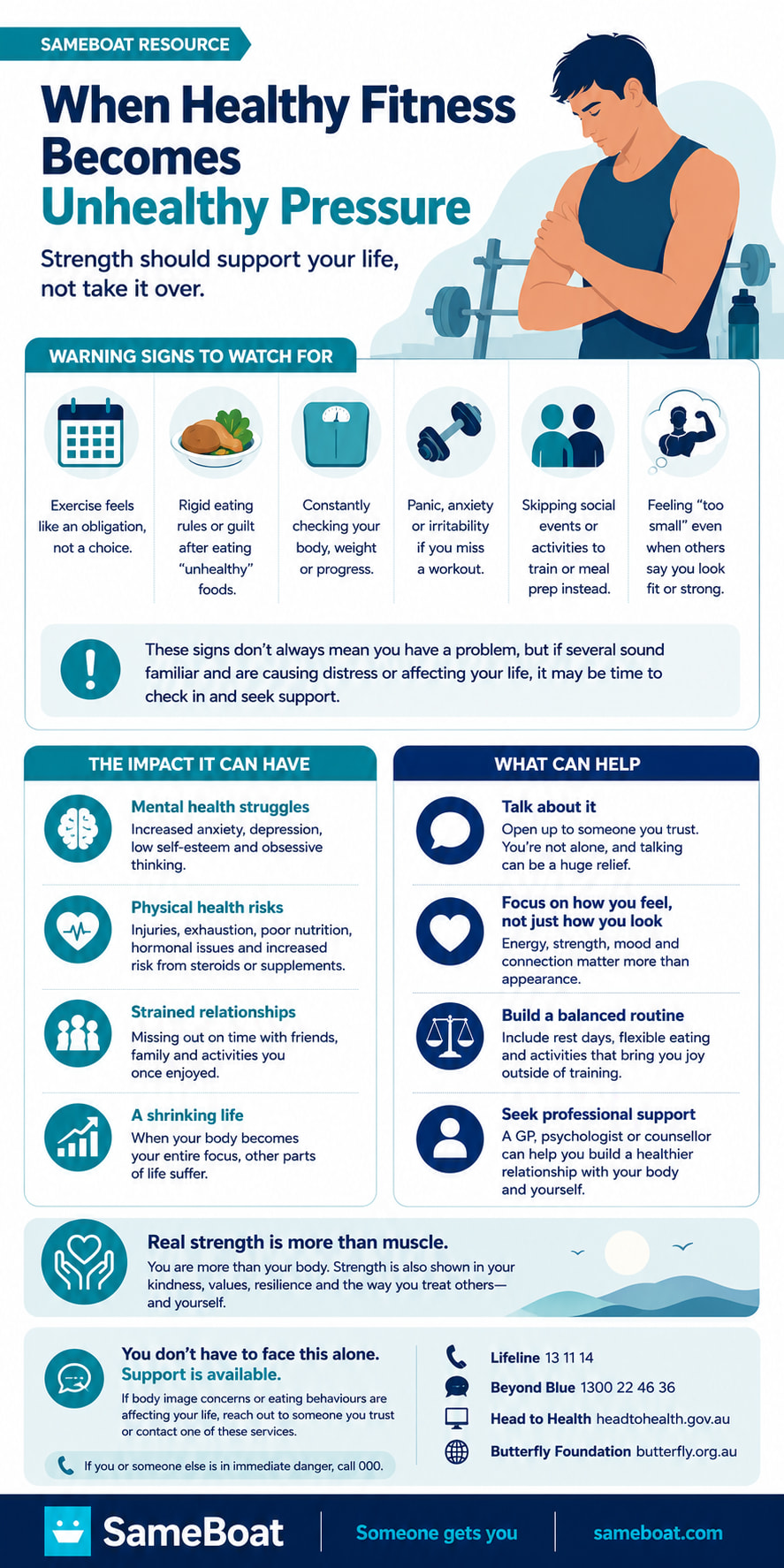
Someone may feel guilty for missing a workout, anxious if they cannot get to the gym, or believe they are “shrinking” after only a day or two without training. They may skip social events, relationships or family activities because their workout routine cannot be interrupted.
Instead of exercise supporting life, life starts revolving around exercise.
“I still look small.”
One of the most confusing aspects of male body image is that someone can be objectively muscular and still believe they look weak or undersized.
This is sometimes associated with muscle dysmorphia, a condition in which people become preoccupied with the belief that they are not muscular enough, regardless of how they actually look.
Friends and family may see someone who appears extremely fit. The person looking in the mirror may see someone who simply isn’t good enough. Like many mental health conditions, this isn’t vanity. It’s a distorted perception that can become deeply distressing.
Food becomes something to control
Body image concerns don’t only affect exercise. Food often becomes highly controlled.
Some people become afraid of eating anything that isn’t “clean.” Others obsessively count every gram of protein, avoid eating out, or experience intense anxiety if they cannot follow their meal plan exactly.
What begins as learning about nutrition can slowly become something much more restrictive. Healthy eating supports life. Disordered eating controls it.
The hidden role of supplements and steroids
The fitness industry is enormous.
Protein powders, pre-workout drinks, fat burners and countless supplements are marketed as essential for building the ideal physique.
While many supplements are relatively harmless when used appropriately, marketing can create unrealistic expectations and encourage the belief that bigger is always better.
For some people, this pressure progresses to anabolic steroids or other performance-enhancing drugs.
These substances may increase muscle size, but they also carry significant risks, including heart disease, liver problems, hormonal changes, infertility, mood changes and depression.
Many people don’t start using them because they want to compete professionally.
They start because they feel they will never be “good enough” without them.
Why boys often stay silent
Many boys grow up hearing messages about toughness, confidence and self-reliance.
Admitting that you’re unhappy with your appearance may not seem to fit those expectations. Some worry they won’t be taken seriously. Others fear people will simply tell them to “go to the gym” or “man up.” As a result, many struggle quietly.
Parents, teachers, partners and friends may notice endless hours at the gym, rigid eating habits or constant comments about being “too skinny” without realising these can sometimes be signs of emotional distress.
What healthy confidence actually looks like
Building strength is not the problem. Lifting weights isn’t the problem. Wanting to improve your fitness isn’t the problem.
The key difference is whether your body serves your life—or your life serves your body.
- Healthy confidence allows flexibility.
- You can enjoy a meal with friends.
- You can miss a workout without panic.
- You can appreciate your progress while accepting that perfection doesn’t exist.
- You can value yourself for qualities that have nothing to do with your appearance.
If this sounds familiar
If you find yourself constantly thinking about your body, avoiding situations because of how you look, feeling guilty whenever you miss exercise, or believing you’ll only be worthy once you reach a certain physique, you’re far from alone.
These struggles affect boys and men of all ages, including athletes, students, professionals and people who otherwise appear confident.
Body image concerns are real.
They deserve the same compassion and support as any other mental health challenge.
Talking to someone you trust—a friend, family member, GP or mental health professional—can be an important first step. Recovery doesn’t mean giving up exercise or health. It means developing a healthier relationship with both your body and yourself. Because real strength isn’t measured by the size of your muscles. It’s measured by your ability to care for your body without letting it define your worth.
Discussion
Have you ever felt pressure to look a certain way because of social media, sport, fitness culture or other people’s expectations? What helped you develop a healthier relationship with your body?
Further support (Australia)
If body image concerns or eating behaviours are affecting your life, support is available.
• Butterfly Foundation – Australia’s national organisation for eating disorders and body image support.
• Beyond Blue – Mental health information and support.
• Head to Health – Government mental health resources and services.
• If you or someone else is in immediate danger, call 000.